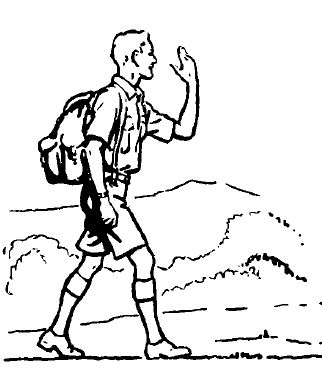

I present this essay on walking and talking by E Kaye from the Melbourne Bushwalkers in the 1954 no 5 edition of the “Walk” magazine.
We have been walking for a long time, we have been walking for millions of years. We have walked a long way. It took us a long time to walk from the Euphrates Valley to the remotest corner of this world. When the world was young and warm we walked to the Poles; as it cooled we walked back again in the teeth of the advancing avalanche of ice. In Biblical times we walked with Moses to Mt. Sinai. It is even recorded that Enoch walked with God. In classical times we walked with the great philosophers Aristotle and Socrates. In the Middle Ages we walked with the Crusaders, and at Canterbury with Chaucer and the pilgrims. In Dickens’ time we walked with David Copperfield to Dover.
But all the time as we walked we talked.
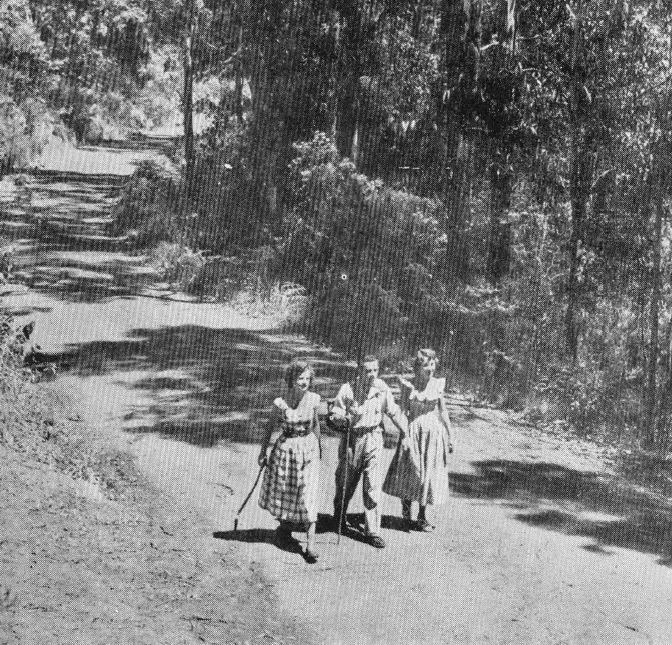
We talked of the food for which we craved, of the good lands we sought. We philosophised; we told risque stories and sang bawdy songs; but we always talked. Even as we walked the beautiful English Lake district with Wordsworth, we talked. But with Stevenson and Hazlitt we walked alone, our only friend, our thoughts. As I contemplated this I felt sad – I felt that something had been lost. I pondered a long time over Stevenson’s graphic words “The traveller becomes more and more incorporated with the material landscape and open air drunkenness grows upon him with great strides”. I found little to console me in them. It did not deny us the right to talk but it prophesied that as certainly as we grow from children to adults so we should increasingly carry the burden of life alone.
Even as I meditated on this I found one who was not prepared to accept the inevitability of this situation gracefully; one in fact who ruthlessly attacked our right to talk. I quote Sidgwick in his “Walking Essays” who charmingly refers to patrols who “Stride blindly across the country like a herd of animals, reeking little of whence they came or whither they are going, desecrating the face of nature with sophism and influence and authority. At the end of the day what have they profited? Their gross and perishable physical frames may have been refreshed, their less gross and equally perishable minds may have been exercised, but what of their immortal being? It has been starved between the blind swing of the legs below and the fruit Iess flickering of the mind above instead of receiving, through the agency of quiet mind and coordinated body, the gentle nutriment which it is due”.
I could not let this go unchallenged. We are essentially gregarious creatures and our craving for companionship is as primitive as our instinct to walk. Despite all the paraphernalia of this mechanical age we are still merely clothed savages and tend to behave as such. We walk to enjoy life and I submit that we cannot enjoy it alone and in silence. Whilst it is true that good companions, like heroes, are not many, nevertheless, in addition to a handful or perhaps only one special friend, almost all who walk and love nature have a human interest story to tell us.
Our walking clubs comprise people from industry, from commerce, from professions, housewives and students who band together to spend their weekends and holidays enjoying one another’s company. In this fuller world into which they escape for little more than a few brief hours we find many of them bush poets, sages, humorists and philosophers of no mean order. Just as modern society for its strength relies on the integrated efforts of all, so the success of a walk is just as certainly bound up with companionship of one another.
Mr. Sidgwick takes umbrage at us “desecrating the face of nature with sophism, influence and authority”. He says it, I am sure, with his tongue in his cheek. We are there primarily because we love nature, as witness our efforts to preserve what remains of our beautiful heritage in as near as possible to its primitive state. We may have influence and authority, we do not I am sure flaunt it on others. Surely, Mr. Sidgwick, the mere exercise of our minds must do something to ennoble our rather indefinable immortal being, residing as it does rather uneasily between our flickering minds and swinging legs. How much better, surely, to discuss and consider the problems that beset us on our journey through this temporal world. How much better to admit that they exist and to discuss them with one another, rather than skate around them as we did when we were jelly fish. What better place to discuss them than in the setting that we have walked in for so long. For in all the hundreds of thousands of years that we have been walking the advent of the road is a most recent development – a most artificial one.
Mr. Sidgwick wrote mainly of England, and of walks along roads and country lanes, stopping frequently for jugs of ale and other refreshments. Our walking is sterner stuff and even in our own beautiful hills around Melbourne we can spend a weekend walking with seldom a sight of habitation; further afield we must carry food enough for a week or more. It is on these trips a good companion is as indispensable as one’s rucksac or boots. The success of the journey depends not on the miles covered, the mountains climbed nor the prize-winning photos collected. Even the scenery is not the most lasting impression, nor is it really diminished by tired feet or aching back. The paramount and valued gain is the happy memories of the talks on the track and the yarns around campfires. These are the values that the philosophers of other days called the highest good.
I contemplated this a while and felt happier; felt, in fact, Mr. Sidgwick had made his remarks with a smile on his lips, with the solemn intention of provoking something that could be argued about for hours: Whether we should talk as we walk.
 The Order Of Walkers