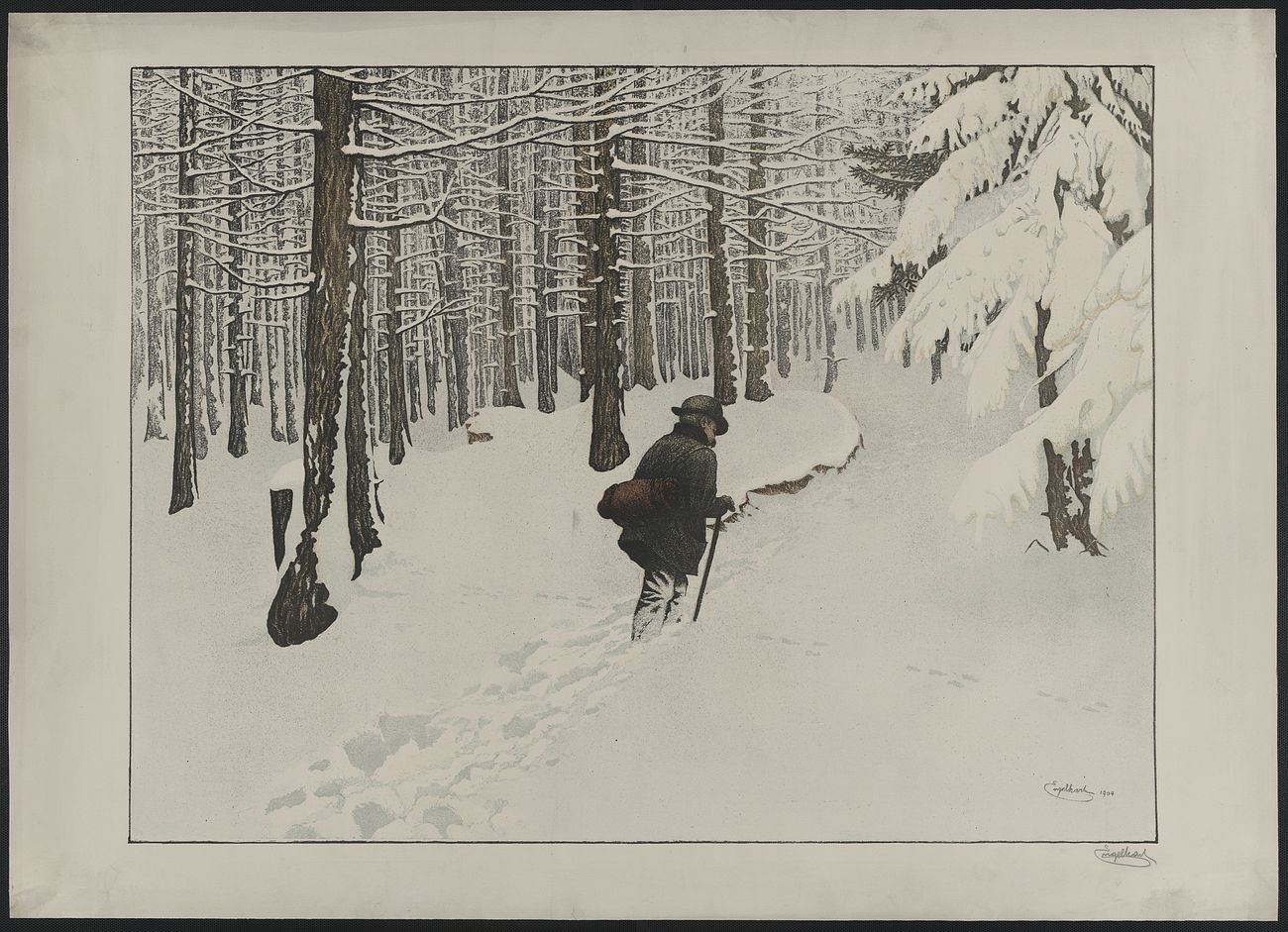
By Arnold Haultain. Published 1914.
In this excerpt Harold articulates the timeless joys of the longer distance walk. The pedestrian of today still shares the same philosophy and creed. It is one of the building blocks that constitutes journey, and indeed contributes to one of the glorious mysteries of walking.
Up to the present we have considered the country walk only. The walking trip or tour is a more serious affair. If it requires as vacuous a frame of mind, it necessitates a more deliberate preparation. Much depends upon the country and the locality chosen. If inviting hostelries abound, one needs to weight oneself with little; if they are infrequent, or nonexistent, food and clothing become matters of moment. This may sound a truism; but it is a truism that many a tripper wishes he had laid more earnestly to heart when, miles from house and home, he finds himself wet, hungry, and fatigued. It is better to carry a few extra pounds far than to run short soon; for a worn-out body means a useless mind, and hunger and cold, with their attendant depression of spirits, not only rob the tour of its pleasure, but rob the tourist of his zest. Start, therefore, comfortable, and comfortably provided. This is not Sybaritism; it is common sense. For an extended trip, send on some luggage ahead, if you can; and some money (I speak of civilised regions). It is impossible, if you are alone—unless, like Stevenson, you hire a donkey—to transport on your own back food and clothing to keep you going for more than a few days at a stretch—unless you shoot, or fish, or trap—which is sport or prospecting, not walking.
Your first care should be for your feet—another truism not seldom neglected. See that your boots fit—fit, remembering that the feet swell (I speak to tenderfoots). If you are unaccustomed to walking, a good plan is to start with an extra pair of leather soles inside your boots. These can be taken out when the feet swell. If you prefer shoes to boots, wear gaiters or putties—to keep out the wet in winter, to keep out the dust in summer. The only occasion upon which I suffered from blisters was on a sixty-mile walk in tennis shoes on a dusty road in August. Take two or three changes of socks. If you walk in a populous region, carry a pair of light shoes. These will come in handy if you run across a friend who asks you to dinner. Carry also a collar or two; not only hosts and hostesses, but landlords and landladies look askance at too trampish an appearance. I once felt rather uncomfortable sitting at the head of a table d’hôte at the excellent Hôtel Kaltenbach on the American side at Niagara (the landlord knew me well), for I was in rough flannels and tweeds, and my fellow-guests were dressed like (and some of them probably were) millionaires and millionairesses. Verbum sapientibus satis.—Do not refuse an invitation to dinner. Follow Napoleon’s advice and let the country you pass through support you, falling back upon your own food-supply when necessary. Help yourself to as much fruit as you can, or as the owners thereof and their dogs permit. A too concentrated diet is unwholesome. Expatiate upon this to the owners of orchards, and—back your theories with a dole.
But nothing equals the evening meal cooked over your own fire—if you are not too tired to cook it. Of the cookery I shall speak later; but the fire is as invigorating as the food. Would you taste the consummation of human masculine contentment, stretch your tired legs before your own fire after a long, long walk followed by a full meal: your chamber, the forest primæval, green, indistinct in the twilight; your couch, the scented earth; your canopy, the heavens, curtained with clouds; in your nostrils the incense of burning wood; in your heart the peace which the world giveth not.—The elaborately ornamented modern hearth, with its carved oak or its sculptured marble, is the direct lineal descendant of the nomad fire—the earliest institution of man, the first promoter of civilisation, the binder together of troglodytic families into tribes. “Hearth and Home” is an ancient, a very ancient, sentiment. It dates back, I take it, to the Glacial Epoch—far enough, in all conscience.—In my mind’s eye I see the shivering Cave-man, appalled at the encroaching ice, the deepening cold. He gathers wood, huddles him in caves, the drops from his furry, ill-smelling clothing (there was no tanning then) sputtering in the flames. For self-protection, and from lack of fuel, family makes alliance with family, and the first-formed human community squats silent about the first-formed human hearth. What friendships must have there been cemented, what tales told; what a strange first unburthening of human heart to human heart! What ecstatic love-making, too, must have been enacted in the darksome corners of the sooty cave, the while the grey gorged hunters snored, and toothless beldames gesticulated dumb-crambo scandal by the smouldering brands!—No wonder præhistoric associations cluster even now about what is too often represented by a flamboyant mantelpiece with immaculate tiles and polished brasses. Pro Aris et Focis! The smoking altar is the consecrated symbol of the lowly hearth.
 The Order Of Walkers