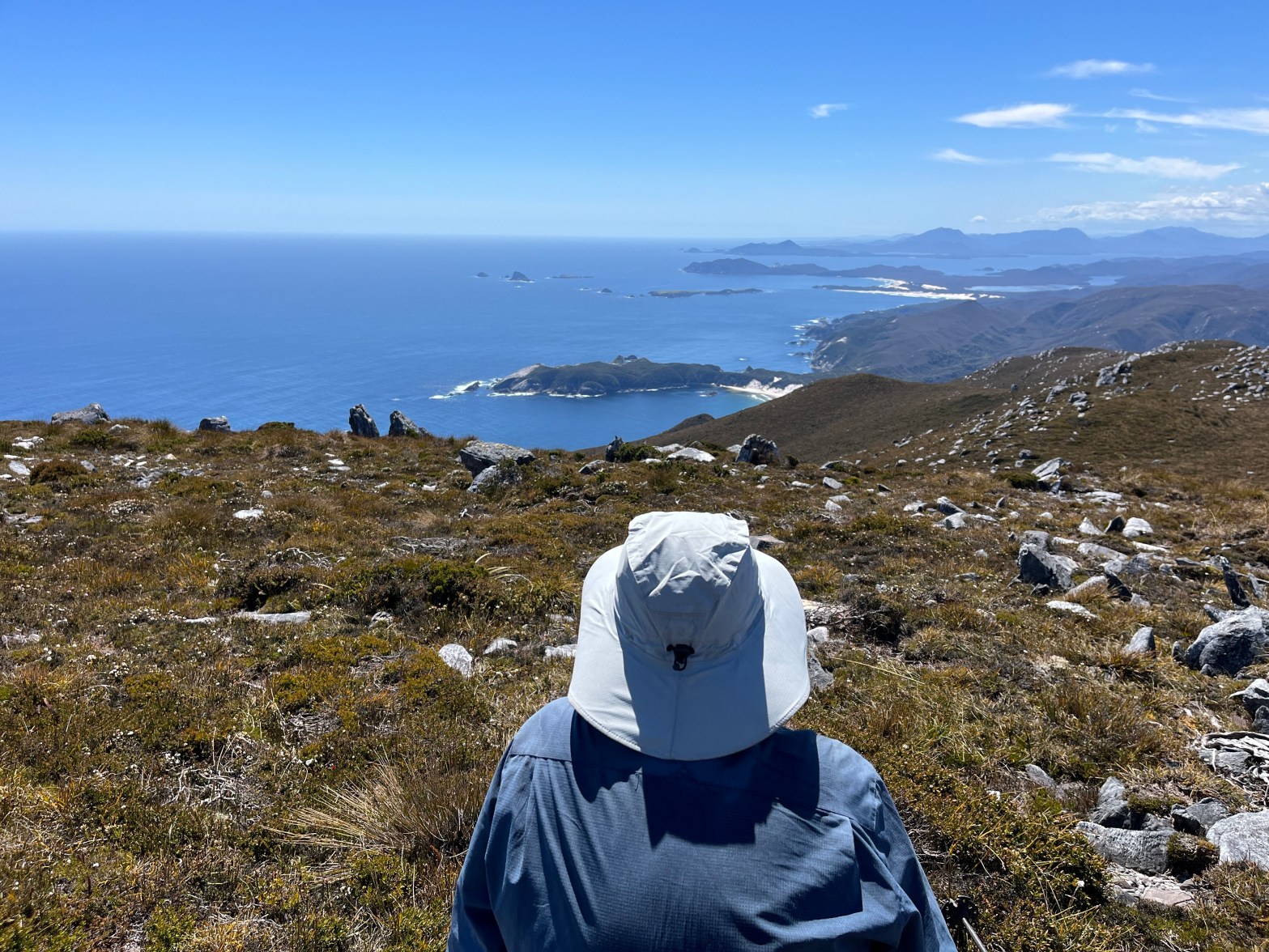
Leave the Sat Phone at home.
Does the carriage of a satellite phone or personal locator beacon on a walking expedition detract from the journey experience?
My provocation to the reader is that personal responsibility and thorough preparation have become an endangered species in the bushwalking world. Modern communications technology is diluting the psychological and formation benefits of wilderness adventure expeditions. Throughout this essay I will contend that bringing a satellite phone or personal locator beacon on a remote area walk is detrimental to the journey experience and we are poorer for it. When we know lifesaving communications technology is in the rucksack the journey is different. I will examine the arguments in five contexts.
- The human condition
- Society impact
- History
- Humans and country
- Technology and its place on country
The overall context for the essay is bushwalking. I am not addressing this essay to high altitude mountain climbers, round the world sailors or those who work professionally in remote environments for long periods.
Country is the term often used by Aboriginal peoples to describe the lands, waterways and seas to which they are connected. The term contains complex ideas about law, place, custom, language, spiritual belief, cultural practice, material sustenance, family and identity1. I am using this word respectfully. Whilst researching this work I came across “the wilderness myth”2 by Professor Michael-Shawn Fletcher, Michael explains to us that Aboriginal people perceive the word wilderness as “sick country”. Non indigenous people perceive the word differently – far from civilization, thick scrub, unspoiled by man. I have used both words in an effort to bring some awareness to those of us ignorant of the first nations position.
Humans are instinctively drawn to the rawness of nature, to be part of something bigger than ourselves. A bush experience can provide a catalyst for change, a transformative shift in thinking or just a reset. Modern society is now risk averse. Those who rage against the bureaucracy of risk are accused of being dinosaurs who are out of touch. I refute that. Risk is a key tenant of what it means to be human, and working with risk is where benefits reside. Bureaucrats have deemed risk too difficult to manage, it costs too much and therefore a sanitised version of a remote experience is delivered. Technology seems to have won the popularity contest to counter such risk. Early explorers and adventurers pushed to corners of the globe without the advanced technology we have today, so why the imperative for us to carry such technology? Our human history is built upon leaving the safety of the campfire and going into the darkness. Going on country is a sure way to build resilience with all age groups but for our young people it can foster a lifelong connection to reality through the changing chapters of life. Few people experience that beautiful exhaustion of a long day in the bush. That exhaustion comes from physical and mental rigour, the product of which, embeds something abstract in the human, something that gives us an edge in this all too comfortable world, when life becomes uncomfortable.
I am not against technology in the wilderness. On all my trips I benefit from lightweight gear. I use a fuel stove to prepare meals, I sleep in a lightweight tent. In the modern world there is inappropriate use of technology, and it has now crept into the sacred space of our excursions on Country.
I ask you to leave your prejudices at this paragraph and continue reading with an untainted outlook. Don’t allow the adult in you to spoil your journey.

The Human Condition
The doctrine of personal responsibility. That long held notion that you are accountable to yourself, that your mistakes are your mistakes and it is not up to the state to come to your rescue. Of course, it is also wrapped up with human pride, which perhaps is why the doctrine still exists within the human condition. When I go on country, either by myself or with a group, I pride myself on the preparation the party does. The preparation allows me to do the journey from my desk. I run possible scenarios, check the functionality of gear, discuss party fitness and check local conditions. By working throughout the preparation stage, a bond begins to form with the party. Strengths and weaknesses are laid out, commitments are forged and a trust is born. When the conversation turns to a PLB or satellite phone to form part of an emergency plan, a sinking feeling envelops. I feel that I am cheating, the group is cheating. What is the point of intense preparation? Are we not confident of our execution? Are we not confident in ourselves? Are we all silently thinking “ if things go pear shaped we can just get a helicopter ride out to hospital”. Is that the type of group thinking you want for your remote bush walk?
In the 1997 American science fiction film “Gattaca”, during the final swimming scene, the two brothers Vincent and Anton are swimming a sea passage. Anton, the Genetically modified child is struggling, he can’t understand how his natural older brother Vincent beat him in previous races. Vincent’s retort
“I never saved anything for the swim back”.3
A commitment to each other is what binds a party on an expedition, and that commitment is your insurance for the excursion.
Humans thrive on the unknown. We live it every day and we all cope. And if we don’t cope, I suppose that means we’ve died, because that’s the end game. You are either alive and sucking the marrow from life or you have taken your last breath. It is as simple as that. Marketing departments are in the business of selling you stuff that will navigate your precious little soul through this unknown realm of fear. They will flesh out this element and present it to you as something that can be solved. Solved with the latest piece of battery powered tech. Solved with the latest prescription pill. Your wilderness expedition should be a sacred space, void of inappropriate technology. Do something radical. Allow your mind to readapt to the olde ways.
A quote from Henry David Thoreau’s 1854 book “Walden” sets the tone.
“I went to the woods because I wished to live deliberately, to front only the essential facts of life, and see if I could not learn what it had to teach, and not, when I came to die, discover that I had not lived. I did not wish to live what was not life, living is so dear; nor did I wish to practise resignation, unless it was quite necessary. I wanted to live deep and suck out all the marrow of life, to live so sturdily and Spartan-like as to put to rout all that was not life, to cut a broad swath and shave close, to drive life into a corner, and reduce it to its lowest terms…”
Humans cannot control everything. It is naive to think that the Global Positioning System that we have all come to rely on will not ever fault. That a mobile phone network will be available %100 of the time, or that modern medicine can cure all. Surely practising the techniques that we can control, is a far more logical notion. I.e learn map and compass navigation, learn remote area first aid.
The stoics have a phrase, “Memento Mori”. It translates as “remember you are mortal”. It is a mantra that firmly places one in the present. When you know you will die, your living can be so much more heightened, you can move past the fear of death. Accept it. If these notions trouble you, then you are not ready for such bush expeditions. Put a rucksack on your back and walk around a footy ground!
Some will think I have gone too far with this statement, for it’s only a bushwalk in a remote area for a period of time. Why do I need to think about my own mortality? It’s supposed to be a fun time in nature. Well, if you have a plb or sat phone on your packing list then it is clear you have thought about your own mortality, but perhaps not to the extent I am putting to you in this essay.

Society Impact
Social values incrementally change over time with wealth and human experience. School camps used to be based around tents and camping. The activities were not sanitised to conform to occupational health and safety regulations, because there were none. There was just common sense. Of course, outdoor education was safe but there was a lot of risk up for exploration and learning. That risk, learning to go to the edge, is pivotal to human formation. The teaching of calculated risk has now changed forever. Children are now admonished and given some sort of school yard punishment if they are caught climbing trees. A simple broken collar bone can be just what a particular child needs at a particular point in time. Risk teaches us to prepare. Teaches us to be self reliant. Teaches us what it is like to have a bit of ticker when it all goes to custard. Skills, vital to broader community formation.

”A challenge in which a successful outcome is assured isn’t a challenge at all.”
Jon Krakauer, Into the Wild
I fear modern society is pushing us to mandate a PLB or satellite phone in a walker’s remote kit. The NSW National Parks and Wildlife Service provides bushwalkers in the Blue Mountains with a free loaned Personal Locator Beacon. We seem to be omitting the skill building aspect of outdoor activities and giving citizens the impression that you can just wander out into the bush with one of these free tax payer funded PLB’s and everything will be alright. Emergency services personnel release media statements indicating it would be negligent for remote walkers to go into the bush without such devices!
On the NPWS site, Personal Locator Beacons and GPS | NSW National Parks is this quote,
“There are many ways technology can help keep you safe in national parks. But it’s still important to plan and prepare for all conditions. Many national parks don’t have mobile phone coverage. If you’re planning a walk in a remote area, bring a Personal Locator Beacon (PLB) as an added safety precaution.”
Dumbing down core values in deference to a PLB.
I note Bushwalking Victoria is the one site I have found that offers some clear thinking on the topic. This excerpt is from the website Overview of emergency communications – Bushwalking Manual
“Carrying an emergency communication device is no substitute for careful planning, good bush and navigation skills, appropriate fitness and equipment and sound leadership.”4
Our emergency services are evidently, generously funded these days. They are advising citizens to carry a PLB when going into a remote area, out of mobile coverage. It is protocol that when an alert is received by the rescue coordination centre in Canberra, the most appropriate rescue method, (4wd/foot or helicopter), will be promptly dispatched. I have formed a view that society has lowered the risk event threshold because an emergency rescue can now be more easily summoned. It is acceptable to “push the button” because career search and rescue staff are on call. Using a satellite phone or PLB is no longer a device of last resort. “Last resort” has indeed become a variable. An excerpt from a 2015 Sierra Club article.
“Examples of rescue-beacon gaffes now abound, like the infamous 2009 “triple play,” when a group of fathers and sons in Grand Canyon National Park activated their SPOT three times in less than 48 hours because their water tasted salty.”5
I wonder in the future, if emergency services were to invoice the PLB button pusher post the evacuation event, whether the mindset would revert to the olde ways?
Walking alone in wild places offers recharge and clarity to the modern human, but today there is unspoken pressure on solo walkers to carry an emergency comms device. A detailed itinerary in the hands of a trusted friend and you, adhering to the planned route, is perfectly adequate for an emergency plan. Of course my usual caveats apply. Do the preparation, build your skills and experience over time, and understand your limitations. Realise in your later years, that some routes and expeditions will be beyond you and you should not be there.
We elect governments to preserve remote bush land amidst a resource hungry society so that we have somewhere to retreat, somewhere to learn about our planet. It is our job to preserve the experience. Relying on emergency tech is not enhancing the experience, it’s papering over a lack of preparation and not allowing you and your party a full immersion. We cannot afford to allow technology policy thought bubbles to dilute the ability for seminal formation encounters. These experiences link us with nature, history, explorers and first nations people.
Howard Zahniser worked for US Wilderness Society (founded in 1937), as their executive secretary and later as the executive director. He authored the original Wilderness Act. Zahniser wrote 66 drafts of the Wilderness Act6 between 1956 and 1964 and steered it through 18 hearings. Its passage in 1964 stands in testament to the dedication and perseverance of this man who deeply felt the worth of wild places.
“I believe we have a profound fundamental need for areas of the earth where we stand without our mechanisms that make us immediate masters over our environment.”
Howard Zahniser
History
Humans have been exploring our planet as part of evolution. It’s in the DNA of the species. We are\were nomadic so that we could survive the seasons, we followed the food supply. We developed astronomical navigation skills, learned to sail, learned animal husbandry and cropped. Olde ways have been handed down for generations. Yes, it was a harder existence, yes, people died, but still great feats of endurance were accomplished and documented. Aside from the degradation of wilderness areas and the oceanic pollution, the basic landscape has not changed. Even today we read books about Shackleton and Hillary. Those stories are compelling because they were a human effort and they taught us of human resilience and endeavour. When explorers left a base camp or port they had no emergency plan. They were self-sufficient. Personal and group responsibility were core values that ensured expedition success. They were the most skilled people chosen for the expedition, they knew the risks ahead of them and yet they embarked into the unknown. Missions to the moon and space were built upon this pioneering spirit that was handed down to a new generation of explorers. Humans thrive on it. It benefits future society and it benefits the species. How will we build upon that pioneering spirit to hand to a future generation when we are teaching “press the button”.
Going into the bush for a few days to explore some remote bushland, is the closest I can come to feeling a gram of that pioneering spirit. Being prepared and leaving the satellite phone at home accentuates that pioneering spirit. It’s the least I can do to feel really alive in an otherwise flatlining world.
Humans and Country
What will you sacrifice for entry into the wilderness? You have to give something of yourself to receive the fruits. I am talking about an investment in your time to prepare and learn. Fitness, rationing and nutrition, navigation, first aid, flora, fauna, history etc. We venture on country because most people don’t, and we relish the challenge in a quiet non competitive way. We might have seen a photograph of a landscape view and have decided to see that ourselves, under our own human power. We spend time in the bush because meaning awaits at the crest of the ridge ahead. You enter the wilderness, on wilderness terms. You must accept that death is a possibility. Memento Mori. Surrender your foolish ideals of control. Your control is limited to footsteps and the load you can carry. You are tiny in the built up world and just a spec in the bush you will travel through. You are signing up to pursue a sense of clarity. Perhaps that clarity will not appear for weeks or years, but as you are processing the experience in the real world, parts of that other world experience will rock your thinking.
‘When the heavy sand is yielding backward from your blistered feet,
Henry Lawson
And across the distant timber you can see the flowing heat;
When your head is hot and aching, and the shadeless plain is wide,
And it’s fifteen miles to water in the scrub the other side –
Don’t give up, don’t be down-hearted, to a man’s strong heart be true!
Take the air in through your nostrils, set your lips and see it through…’
Many people are just not equipped to venture to some remote bush locations. Overweight, underweight, lack of fitness, lack of confidence. lack of experience. Giving those people a satellite phone or PLB only offers a false sense of security. They should build skills over time and embark on the journey in good time. Remote bush journeys should never be made easy for the masses. I applaud grassroots lobby groups and government departments for maintaining a hard line stance against soft tourism development. Some things are supposed to be hard. It challenges the human and sets the bar.
Just because you are venturing into the bush doesn’t mean you are more likely to have a life threatening event and you should bring a PLB. Knowing what you will do to remedy the situation is a prerequisite. We should not outsource our responsibilities to others because it’s the easy option. People generally seem to link PLB’s and satellite phones with snake bites. Let’s look at some Australian snake bite statistics for some perspective and cut through media fanned fear.
Approximately 3000 snake bites are reported annually. Of these, 300-500 people are hospitalised. There are 2-3 deaths per year. The average time to death is 1 to 19 days.7
Public health expert at the Australian Venom Research Unit (AVRU) at the University of Melbourne, Dr Ronelle Welton led a 2017 study, published in the journal Toxicon. Dr Welton said the review challenged widely held assumptions.
“While the perception remains that snake bite incidents occur in rural areas, we found that nearly half the incidents occurred in an urban environment,” Dr Welton said. “Most incidents occurred in warmer seasons when snakes were more active. Most bites occurred on limbs, and up to seven people (one fifth of fatal victims) were reported to have been bitten while trying to pick up or kill snakes.”8
Given the prompt requirements of snake bite treatment, your snake bite kit and training will be what saves a life and not reaching for the satellite phone. A severe allergic reaction (anaphylaxis) due to an insect sting is another more likely concern for your timely consideration. A satellite phone won’t help you. The prompt use of an epipen for a shot of adrenaline is your course of action. Do a remote area first aid course and empower yourself and others.
As far as I know the best practice for an emergency plan is to “tell someone before you go”. Your emergency plan document will have the itinerary details, along with a time to call the authorities should a scheduled return not be made. This document should be given to a contact that can be trusted to enact the emergency plan should the criteria be met. The authorities can then despatch the most appropriate assistance. When you come across an intentions book, fill it out. Parks staff check these books when an alarm is raised. A simple plan that rarely gets activated.
Technology and its place on country
Technology has a place in your wilderness kit. The smartphone, prepared with some appropriate apps, pretty much means you will never be lost again. Depending on the length of your expedition you may need to bring a power bank, but with this one device in aeroplane mode you can
- Take geotagged photos
- Capture video
- Use GPS to navigate with Avenza offline maps
- Site yourself with “What Three Words” or Ëmergency Plus”
- First Aid Guides
- Useful field guides for fauna and flora
- Make audio notes
Of course, you could even leave the smart phone in your car and have a vintage expedition experience, but given the above functionality, it’s a tough ask these days. Your compromise is to activate flight mode, turn those distracting notifications off and use the device appropriately for the space you are in.
In most cases, (a serious first aid incident is rare), a satellite phone is just going to interrupt the immersion. Do you really need to send update messages to your loved ones that everything is ok? Do you really need to know that your test results have come back positive and you have cancer? This disconnection from the real world is the very reason you are out on remote country. Your re-entry into the real world will come soon enough. Lap up this unique period of time, where you can be with your friends and country. Something special may transcend.
If someone in your party has done themselves a mischief, the party will take control of the situation. You have done the first aid training. You have splinted the ankle, bandaged the limb or put a hypothermic patient into a sleeping bag. You have done your best. You now wait and deliberate on the next step according to consequences. Plan A may well be aborted and a new adventure foisted upon the party with unknown outcomes. Perhaps you will determine who in your party will walk out and raise the alarm or maybe a stretcher will be rigged and the party walks out together. These are the hallmarks of a remote area expedition. This is what you prepared for. In the case of chest pain, think heart attack, there is the obvious first aid procedure, but if it is a massive heart attack then, sadly, time is being called for your friend. No satellite phone or PLB is going to change the outcome.
Let’s suppose a situation is dire, and the PLB button is pressed. What happens if it doesn’t work? What happens after a day and nobody has shown up?
Same situation for a satellite phone. I try to make a call to the hospital to get some advice about a symptom of abdominal pain. The phone doesn’t turn on, I am in a dead zone for satellite coverage. I find myself at square one and relying on my own steam and wits to deal with the situation.
I would put it to you that if you have not qualified for the excursion by way of experience and preparation and you elect to carry a PLB or satellite phone then you are the negligent party, not the other way around.
What is a device of last resort? This phrase is now open to interpretation due to changing social values. Most people these days would not be comfortable anywhere near the phrase “last resort”. Emergency services would be summoned a long time before “last resort” because citizens have been told they can.
There is a movement of athletes coming under the banner of “Fastest known time”. These men and women spend their time in the wilderness going from a to b as fast as possible and then post their fast times. Now whilst this practise is an anathema to me, I admire their tenacity and ticker but that’s where it ends. Given their lightweight gear status to achieve these fastest known times, they almost always have a PLB dangling from a shoulder strap. They don’t carry a comprehensive remote area first aid kit, extra food or warmer clothing. Add to that, they are rushing. Mistakes are bound to be made when you rush. These hikers are definitely using modern technology as their emergency plan and I cannot see any justification for the public purse to fund an extraction for one of these “adventurers”, all for the vain attempt to complete a walking track by the fastest known time.

In conclusion, as to my position on the topic, I also need to reflect on my own human frailties. Am I just vain or stubborn? Why don’t I just roll over and accept what is now the norm? Of course it’s possible that I am out of touch and have not embraced this evolving notion of preserving human life at all costs. That it is my right to go anywhere around the country without applying due diligence and if something goes wrong, the state will rescue my precious soul.
This question of personal responsibility and the use of emergency technology in the wilderness, when stripped naked, is about an ignorance to prepare in deference to a lightweight piece of tech that can summon assistance. On another level it is about a privileged people’s inability to confront and accept our own mortality. We have become so detached from nature, that we fear the natural cycle of life, and when we go adventuring on country we have to safeguard against this natural cycle. If you have comprehensively prepared as I have discussed, if you have philosophically challenged yourself, you too may come to the conclusion that a satellite phone or PLB is superfluous kit.
I believe, as experienced walkers, we have an obligation to young people and those taking up distance walking to promulgate the importance of preparation and personal responsibility. Take time to chat about core values, skills and the why. Why do we do these excursions on country? Why do we return to country where only type 2 fun exists? Why do we disconnect from communications technology when we are in this other world?
I realise that I cannot turn back time. Tech boffins will always try to tame the divide between civilisation and country with black box technology and the market will mostly accept it. It is Inevitable that satellite technology will merge with consumer phones and then my argument will be even more difficult to prosecute! My main point will still be very relevant. Prepare and take personal responsibility for your excursions into the bush. Push “last resort” right back to where it was born and if you have to press the button, or make the call and you feel a little embarrassed about doing it, then you know you have been true to the olde ways and yourself in this modern world.
Respect your bush journey by bringing some humility to the track. Leave your material baggage at the car park. As you sojourn, and if you are open, there’s a chance you will be vested with the abstract notion of journey, a notion that evades concise articulation, but beats strong during and after your remote wilderness expedition. It’s the notion that underpins the desire to travel to unknown places locally and overseas. Remove the external stimulus, lower the heart rate, mark some time and just be.
To those who currently carry such equipment I offer this challenge. Remove the device from your packing list and then consider the implications for the modified packing list. Is there anything you need to add? Did it make you think about a first aid refresher course? Does it make you feel uneasy about doing the excursion?
An authentic journey experience awaits those who work without a net, those who harness human power, believe in themselves completely and have made peace with their own mortality.
Bibliography
- Technology – Wilderness Connect
- https://ijw.org/technology-in-wilderness/
- https://www.sciencedirect.com/science/article/pii/S014019711600049X
- Adventure-based mindsets helped maintain psychological well-being during COVID-19 – PMC
- (PDF) Keeping the wild: against the domestication of earth
- The wilderness myth – ABC listen
- More than half Australian snake bite deaths since 2000 occurred at victim’s home
- Fatal snake bites in Australia: facts, stats and stories
- Incidence of fatal snake bite in Australia: A coronial based retrospective study (2000-2016)
- https://aiatsis.gov.au/explore/welcome-country#:~:text=’Country%20is%20everything.,to%20which%20they%20are%20connected.
↩︎ - The Wilderness Myth. Professor Michael-Shawn Fletcher
Indigenous knowledge and the persistence of the ‘wilderness’ myth
↩︎ - Gattaca is a 1997 American science fiction film written and directed by Andrew Niccol in his feature directorial debut.
Gattaca – Never saved anything for the swim back
↩︎ - https://bushwalkingmanual.org.au/emergencies/emergency-communications/overview/ ↩︎
- https://www.sierraclub.org/sierra/2015-4-july-august/feature/danger-life-saving-device ↩︎
- https://www.wilderness.org/articles/article/wilderness-act ↩︎
- https://www.theguardian.com/environment/2017/mar/23/more-than-half-australian-snake-bite-deaths-since-2000-occurred-at-victims-home ↩︎
- https://www.unimelb.edu.au/newsroom/news/2017/march/fatal-snake-bites-in-australia-facts-stats-and-stories ↩︎
 The Order Of Walkers