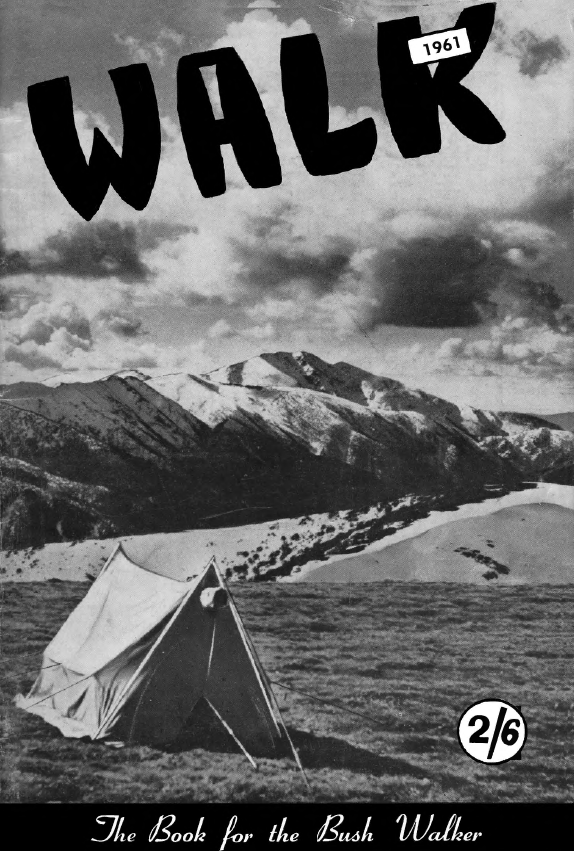
This essay by club member, Sam Larsen in 1961, is a lesson in aspiration. It’s a blueprint to the olde ways of bushwalking before our society was dumbed down by labour saving devices. He is gifting us the tried and tested techniques to thrive in the outdoors, gifting us some preparation dot points.
Walk magazine was the journal of the Melbourne Bushwalking club.The magazine was published annually between 1949 and 1987 and was for members to record matters of interest to the general public who were interested in bushwalking. Today, the pages of the magazine with their detailed walk descriptions and topics of interest to bushwalkers stand as an invaluable historic record.
Walk – A Magazine of Melbourne Bushwalkers
When reading these pages you may often have wondered just how good all these fine walkers really are. Well, of course the answer is that most of them are very nearly perfect; maybe you can recognise them from the following specifications.
Firstly, it is a “sine qua non” (without which not) that a walker should have the physical strength and stamina for the particular walk he has chosen, and he should be so trained that he won’t be a burden on his companions. A reliable pair of feet, sturdy legs and a powerful torso are essential to support him and his pack.
Secondly, he should be able to appreciate Nature in her widely different forms: the many varieties of gum trees, tall and straight with their green leaves that are not shed in Autumn; the sight and scent of the golden wattle and numerous species of wildflowers in bloom in Spring time; the joy of awakening to the clear, shrill notes of the lyre bird, the laughing kookaburra and the melodious magpie; the thrill of climbing a peak in the crisp, early morning to see the sunrise; the rugged grandeur and majesty of the distant mountains; the beauty of the hills in a mantle of snow; the music of the rippling stream; and the rainbow with its merging of each colour into another.
The third requirement of our ideal walker is that he is a natural leader: he has that personal magnetism that inspires people and binds them together; he is always master of the situation with the calmness of the veteran. He has, before the walk, studied all maps and learned what he could about the area, so that no matter what sort of emergency he is faced with, his knowledge and experience of conditions will enable him to reach a sound decision.
Fourth on the list is that invaluable asset, a sense of direction. The wise walker, however, knows that his sense of direction is not infallible, so always has a good compass with him. It is no trouble for him to convert a magnetic bearing to a true bearing and vice versa when the occasion requires it to be done. He may, at times, want to make sure that his compass is working properly, one reason being that he may be in country which has deposits of iron-stone – causing his compass-needle to deflect. In this event, he knows of several methods by which approximate directions may be obtained: for instance, he knows when the sun will be true North – its highest point, which occurs, on the average, at 12.20 p.m. in Melbourne- and that it changes direction at about 15 degrees per hour – so that its position may be estimated for any hour of the day with reasonable accuracy.
The next attribute is that he has the pioneering spirit: the desire to be the first to climb a peak, to fearlessly blaze the trail through country which no man has gone before. In short, he has the curiosity to see for himself – regardless of personal safety – what is around the corner.
Our walker is, of course, observant. He notes each track and its direction, each stream he crosses and checks it on his map. He has that uncanny knack of being able to recognise surrounding peaks, though they have changed slightly in appearance due to being viewed from a new angle. He takes in the general pattern of the district; whether it is densely timbered or not, flat or hilly and wet or dry. No bird or animal escapes his attention, and he is at all times alert to the danger of snakes.
He is skilled in bushcraft: he knows that water is even more necessary than food, and can find a creek or water-hole in apparently dry country. As far as food is concerned, he can, in an emergency, live off the land from fruits, berries. roots. animals, fish. birds. etc. In the coldest and wettest weather he can always light a fire and so keep warm.
When first-aid needs to be rendered, his training stands him in good stead, and he is able to give prompt assistance to the victim – no matter whether he is suffering from a sprained ankle or a broken limb. He is always pleasant and cheerful, and has a sense of humour for even the darkest occasion. He has the personality needed to mix with different types of walkers and generally put them at their ease. He has a repertoire of folk songs and bush-ballads which he uses around the camp-fire at night, and can strum a banjo or play a mouth-organ to entertain his fellow-walkers.
When it comes to selecting the equipment that he has to carry, he sees that he gets durable, lightweight material that can be put into a small space in his pack. He carries many items of gear throughout different trips, but is never without matches, a torch, a watch and a compass. He knows that if he treats his equipment well it will treat him well in return – in particular his watch. Accessories often used to advantage are cameras and binoculars, etc.
Over the years he has built up a knowledge of the foods needed to sustain him on his journeys. Circumstances demand that they be as nourishing as possible for their weight and volume; he works on the theory that his pack will be lighter if he carries dried and dehydrated foods – water being obtained at the camping site. Our seasoned walker can cook quite a well-balanced and appetising meal.
Naturally, he chooses his clothing with care, and it sees him through all vagaries of weather.
Finally, he knows that walking is a natural, healthy exercise, and he finds contentment in the peaceful serene world of Nature.
 The Order Of Walkers