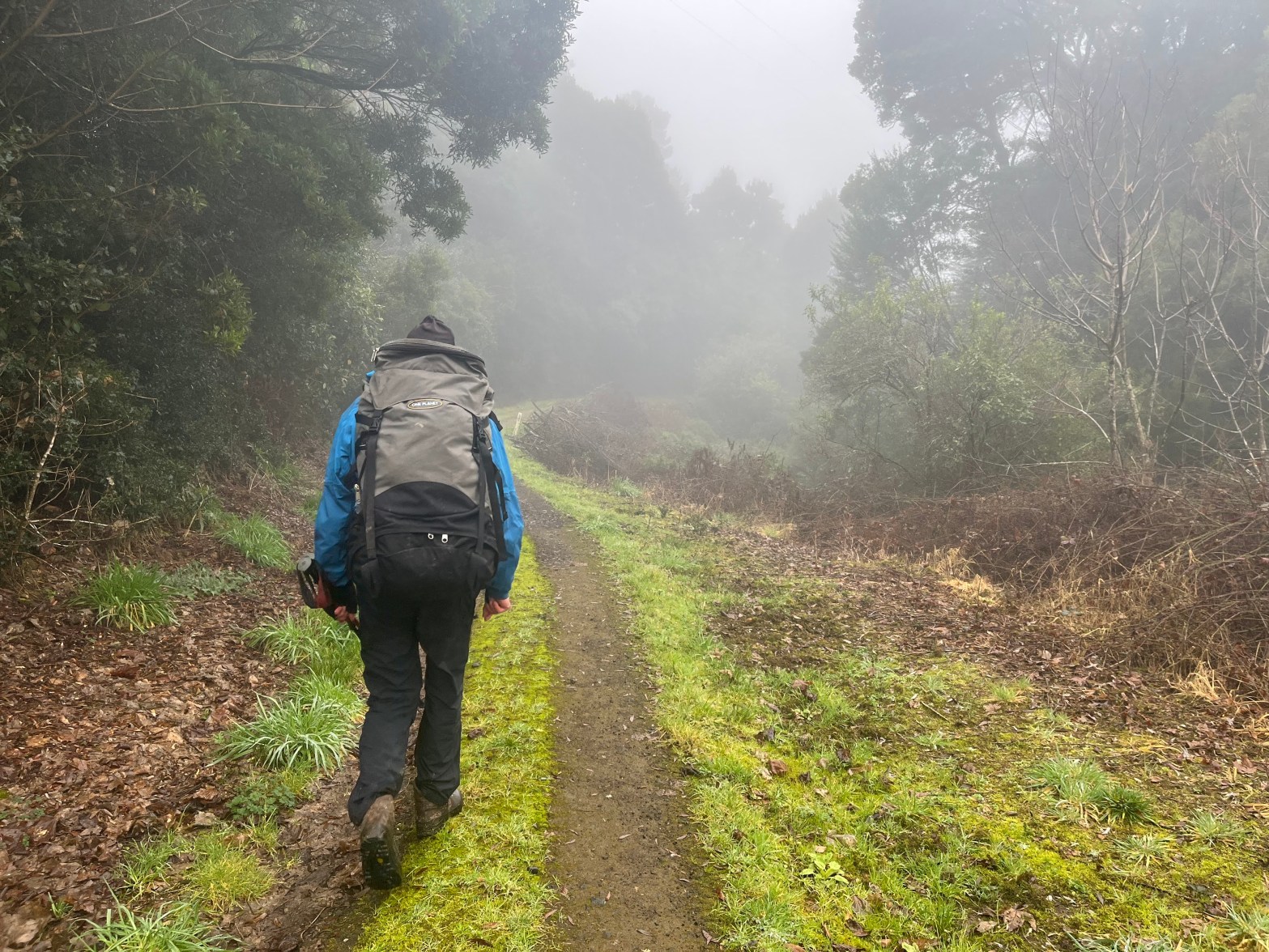
And now for some hints on the practical details of walking tours of more arduous character and more extended length.—Suit the weight of your knapsack or pack to your strength, leaving a large margin for comfort. If you travel in regions uninhabited by man, and the climate is rigorous, a shelter at night is all-important. Therefore carry a light blanket: a warm head and face induce sleep; so does a change to dry underclothing at the end of the day. For really hard trips, when you walk all day and walk far, you will need, to replace used-up muscular tissue, each day:
¾ lb. of flour;
¾ lb. of bacon;
½ lb. of beans;
—and to these you should add dried fruit or rice. The best dried fruit is a mixture in equal parts of apricots and prunes. Take an abundance of tea: nothing takes the place of tea; and supply yourself with pepper, salt, sugar, candles, and soap. Your cooking pots should fit the one into the other. These things, with a small frying pan, an axe (to cut poles for your evening shelter and wood for your fire), a file to sharpen this, and some stout wire hooks by which to hang your pots over the fire, complete, I think, the sum-total of your absolutely necessary impedimenta.
The sedulous, however sage, have little idea how large a part of active life depends on food. To stay-at-homes, who go down to the dining-room when the gong sounds, a meal seems a mere incident of life, an intermission from work, an opportunity for a family chat. The traveller on foot soon learns that a meal is of the most vital importance. Every reader of Nansen’s thrilling narrative must have noticed this. Even in Mr Belloc’s literary “Path to Rome” one is struck with the intrusion of this unliterary topic, and the more literary “Inland Voyage” of Robert Louis Stevenson is not free from it. While even in that delightful, and delightfully feminine, “An Oberland Chalet,” which I have already cited, although the foods were generally cheese or cakes or petits pains, and the drinks chocolate or milk or café au lait, the mention of edibles and potables is frequent.
The importance of a supply of food has so often been borne in upon me that I am inclined to believe that the political community is coæval with the pantry. Even amongst animals, only those form commonwealths which form common stores of food—as the ant and the bee. The pedestrian gains a practical insight into this wide-reaching influence of a storage of food. Not for half-a-dozen hours can he subsist before its importance is impressed upon him by most painful pangs. If, therefore, sedulous sage, you set out on a long hard walk without due provision for the allaying of hunger, you will come to grief. I make no apologies, accordingly, for minute instructions on that topic here.
In this excerpt Harold articulates the timeless joys of the longer distance walk. The pedestrian of today still shares the same philosophy and creed. It is one of the building blocks that constitutes journey, and indeed contributes to one of the glorious mysteries of walking.
Up to the present we have considered the country walk only. The walking trip or tour is a more serious affair. If it requires as vacuous a frame of mind, it necessitates a more deliberate preparation. Much depends upon the country and the locality chosen. If inviting hostelries abound, one needs to weight oneself with little; if they are infrequent, or nonexistent, food and clothing become matters of moment. This may sound a truism; but it is a truism that many a tripper wishes he had laid more earnestly to heart when, miles from house and home, he finds himself wet, hungry, and fatigued. It is better to carry a few extra pounds far than to run short soon; for a worn-out body means a useless mind, and hunger and cold, with their attendant depression of spirits, not only rob the tour of its pleasure, but rob the tourist of his zest. Start, therefore, comfortable, and comfortably provided. This is not Sybaritism; it is common sense. For an extended trip, send on some luggage ahead, if you can; and some money (I speak of civilised regions). It is impossible, if you are alone—unless, like Stevenson, you hire a donkey—to transport on your own back food and clothing to keep you going for more than a few days at a stretch—unless you shoot, or fish, or trap—which is sport or prospecting, not walking.
Your first care should be for your feet—another truism not seldom neglected. See that your boots fit—fit, remembering that the feet swell (I speak to tenderfoots). If you are unaccustomed to walking, a good plan is to start with an extra pair of leather soles inside your boots. These can be taken out when the feet swell. If you prefer shoes to boots, wear gaiters or putties—to keep out the wet in winter, to keep out the dust in summer. The only occasion upon which I suffered from blisters was on a sixty-mile walk in tennis shoes on a dusty road in August. Take two or three changes of socks. If you walk in a populous region, carry a pair of light shoes. These will come in handy if you run across a friend who asks you to dinner. Carry also a collar or two; not only hosts and hostesses, but landlords and landladies look askance at too trampish an appearance. I once felt rather uncomfortable sitting at the head of a table d’hôte at the excellent Hôtel Kaltenbach on the American side at Niagara (the landlord knew me well), for I was in rough flannels and tweeds, and my fellow-guests were dressed like (and some of them probably were) millionaires and millionairesses. Verbum sapientibus satis.—Do not refuse an invitation to dinner. Follow Napoleon’s advice and let the country you pass through support you, falling back upon your own food-supply when necessary. Help yourself to as much fruit as you can, or as the owners thereof and their dogs permit. A too concentrated diet is unwholesome. Expatiate upon this to the owners of orchards, and—back your theories with a dole.
But nothing equals the evening meal cooked over your own fire—if you are not too tired to cook it. Of the cookery I shall speak later; but the fire is as invigorating as the food. Would you taste the consummation of human masculine contentment, stretch your tired legs before your own fire after a long, long walk followed by a full meal: your chamber, the forest primæval, green, indistinct in the twilight; your couch, the scented earth; your canopy, the heavens, curtained with clouds; in your nostrils the incense of burning wood; in your heart the peace which the world giveth not.—The elaborately ornamented modern hearth, with its carved oak or its sculptured marble, is the direct lineal descendant of the nomad fire—the earliest institution of man, the first promoter of civilisation, the binder together of troglodytic families into tribes. “Hearth and Home” is an ancient, a very ancient, sentiment. It dates back, I take it, to the Glacial Epoch—far enough, in all conscience.—In my mind’s eye I see the shivering Cave-man, appalled at the encroaching ice, the deepening cold. He gathers wood, huddles him in caves, the drops from his furry, ill-smelling clothing (there was no tanning then) sputtering in the flames. For self-protection, and from lack of fuel, family makes alliance with family, and the first-formed human community squats silent about the first-formed human hearth. What friendships must have there been cemented, what tales told; what a strange first unburthening of human heart to human heart! What ecstatic love-making, too, must have been enacted in the darksome corners of the sooty cave, the while the grey gorged hunters snored, and toothless beldames gesticulated dumb-crambo scandal by the smouldering brands!—No wonder præhistoric associations cluster even now about what is too often represented by a flamboyant mantelpiece with immaculate tiles and polished brasses. Pro Aris et Focis! The smoking altar is the consecrated symbol of the lowly hearth.
For many reasons, walking seems to be an ingrained instinct of mankind. I cling to the perhaps fanciful theory that no primitive instinct of man is altogether lost. It is modified, amplified, refined; that is all. With all our culture, we are barbarians still. Man is a clothed savage. And now and again he delights in doffing the clothing and returning heartily to savagery. How delightful the feel of the briny breeze and the boisterous wave on the bare pelt! Mr Edward Carpenter rails at the (I think) eleven layers of clothing that intervene between our skins and the airs of heaven. Walt Whitman revelled nude in his sun bath. What a treat too, sometimes, to get away from the multi-coursed dinner and to bite downright audibly into simple food in the fresh air, and to lap water noisily from the brook!
Well, walking, perhaps, is the primal instinct, ancient as Eden, where the Lord God walked in the garden in the cool of the day. And, if my theory is correct, walking will persist till in recovered Paradise man walks with his Maker again. No mechanical contrivance for locomotion will extirpate the tribe of tramps, of those who walk from love of walking.
This is an excerpt from a delightful vintage book by the said author. Haultain circles around all facets of walking during his time in the 1900’s. As one works one’s way through the book the reader will be struck by the fact that not much has changed with our vocation throughout the years. You will be smitten with the long gone turn of phrase. More passages of text will appear over time.
For, mark you, the essence of a country walk is that you shall have no object or aim whatsoever. The frame of mind in which one ought to set out upon a rural peregrination should be one of absolute mental vacuity. Almost one ought to rid oneself, if so be that were possible, even of the categories of time and place: for to start with a determination to cover a certain distance within a specified time is to take, not a walk, but a “constitutional”; and of all abortions or monstrosities of country walks, commend me to the constitutional. The proper frame of mind is that of absolute and secure passivity; an openness to impressions; a giving-up of ourselves to the great and guiding influences of benignant Nature; a humble receptivity of soul; a wondering and childlike eagerness—not a restless and too inquisitive eagerness—to learn all that great Nature may like to teach, and to learn it in the way that great Nature would have us learn.
Yet, true, though we take with us a vacuous mind, it must be a plenable mind (if I may coin the word), a serenely responsive mind; otherwise we shall not reap the harvest of a quiet eye.
“How bountiful is Nature! he shall find Who seeks not; and to him who hath not asked Large measure shall be dealt,”
sings Wordsworth; and of Nature and of Nature’s ways no one had a greater right to sing. Wordsworth must have been an ideal country walker. “The Excursion” is the harvest of innumerable walks, and when Wordsworth depicts the Wanderer he depicts himself:
“In the woods A lone Enthusiast, and among the fields, Itinerant in this labour, he had passed The better portion of his time; and there Spontaneously had his affections thriven Amid the bounties of the year, the peace And liberty of Nature; there he kept, In solitude and solitary thought, His mind in a just equipoise of love.”
Only, “the w . . . w . . . worst of W . . . W . . . Wordsworth is,” as a stammering friend of mine once remarked, “is, he is so d . . . d . . . d . . . desperate p . . . pensive.” (I was expecting a past participle, not an ungrammatical adverb for the “d.”)—He is; and like, yet unlike, Falstaff, he is not only pensive in himself, but he is the cause of pensiveness in other things—to wit, his “stars,” his “citadels,” and what not; and certainly his diary of “A Tour in Scotland” makes the driest reading I know.—Nevertheless, Wordsworth must have been an ideal country walker. He was
“A lover of the meadows and the woods, And mountains; and of all that we behold From this green earth”; and if we would understand him, we ourselves must “Let the moon Shine on us in our solitary walk; And let the misty mountain winds be free To blow against us.”
In this Essay Arthur writes of the transcendental fruits of a long walk. A new, very natural routine evolves and is dictated by walking pace.
“But by about day three, these torments begin to subside as the walk begins to slow the mind to the speed of the body at a pace that is natural and unforced. The walk becomes a long piece of music —andante, of course that neither lags nor hurries.”
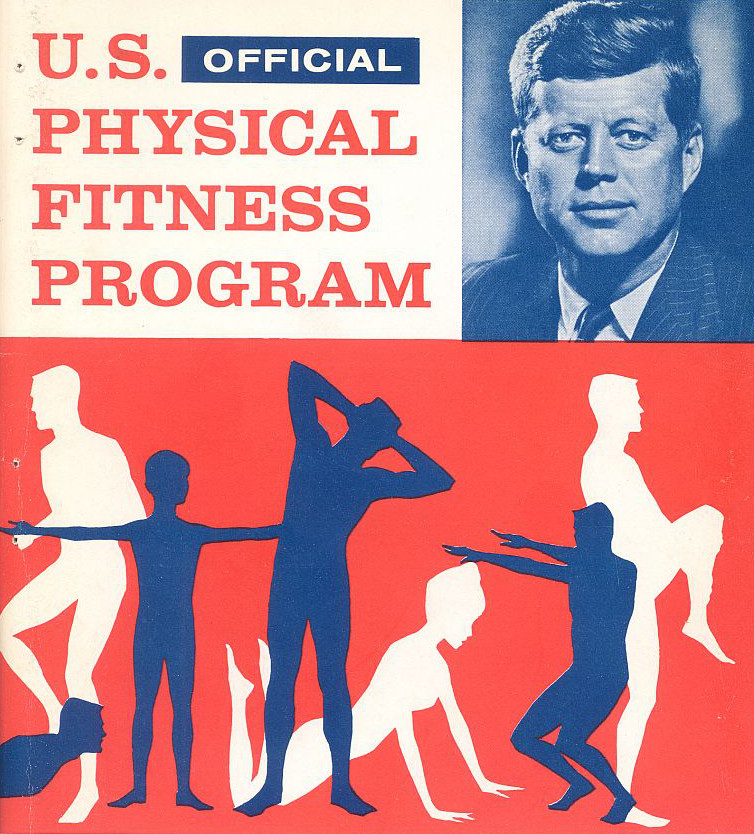
“Physical fitness is not only one of the most important keys to a healthy body; it is the basis of dynamic and creative intellectual activity. . . . [We] know what the Greeks knew: that intelligence and skill can only function at the peak of their capacity when the body is healthy and strong; that hardy spirits and tough minds usually inhabit sound bodies.
In this sense, physical fitness is the basis of all the activities of our society. And if our bodies grow soft and inactive, if we fail to encourage physical development and prowess, we will undermine our capacity for thought, for work and for the use of those skills vital to an expanding and complex America.
Thus the physical fitness of our citizens is a vital prerequisite to America’s realisation of its full potential as a nation, and to the opportunity of each individual citizen to make full and fruitful use of his capacities.”
Archive from 1980 featuring Jock Nimlin, Tom Weir, Robert Grieve and others.
Some wonderful recollections of adventures in a simpler time. There is much to be gained from those who adventured before us. If you’re sitting back listening to this and getting glassy eyed about the past, remember that you can recast your own walking adventures in a similar vein. Shed the technology, ditch or postpone responsibilities and go.

 The Order Of Walkers