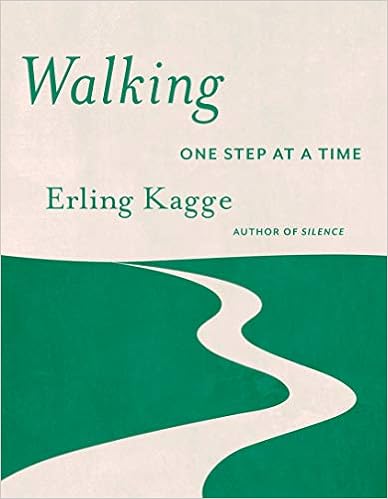
Erling Kagge is an adventurer, philosopher and father. In 2019 he released his book “Walking: One step at a time” Brett Mackey at the Art of Manliness spends 45 minutes speaking with Erling talking about walking.
"If you are seeking creative ideas, go out walking. Angels whisper to a man when he goes for a walk." – Raymond Inmon
Erling Kagge is an adventurer, philosopher and father. In 2019 he released his book “Walking: One step at a time” Brett Mackey at the Art of Manliness spends 45 minutes speaking with Erling talking about walking.

As the car made its way up the tarmac ribbon that runs from Harrietville to the top of Mt Hotham, the setting sun filtered its way through the trees. One of the intrepid hikers aboard took a moment to enjoy the comfort he would leave behind for the next few days. He closed his eyes and smiled, enjoying the dysrhythmic dance of light and shade being performed upon his eyelids.
In time the car climbed above the snowline and disgorged its occupants. They stood on the slopes of the broad mountain looking across the ridge to the north, the left hand side of their faces painted a gentle orange by the hazy orb that hung so low in the sky it seemed beneath them.
The Razorback – the ridge upon which they would be walking was well named as each undulation that rose along it bore an undeniable resemblance to the lumbar joint of a giant. The spine of this sleeping titan stretched far out into the distance, crowned by a steep conical peak ten kilometres away – Mt Feathertop.
With nary of word said among them, the group of five shouldered their packs and set off down the track that led along the ridge. Such was the ethereal calm that soon fell over the party that conversation seemed an unnecessary ornament to the occasion. In the distance the occasional cry of an unseen bird was all that could be heard beyond the crunching footfall of the five men.
The world – the other world, full of demands and denials became hard to perceive, hidden behind the veil of nature that had been drawn around them. Payrolls and pay rises seemed inconsequential as the soft light of dusk gave way to the clarity of night. To the west the sun fell below the horizon as a hunter’s moon rose in the east. Up the centre of the celestial equilibrium walked the hikers, each man in his own headspace, interpreting the outlook in his own way.
The stars came out so slowly, no-one was sure when they had first appeared. Of course, they had always been there, even in the daytime, staring down dispassionately from the heavens. But they did not seem indifferent to the walkers – they were as benevolent as the maternal moon which lit the way across shards of granite and mounds of loam that lay across the track.
In the cooling alpine air, a faint umbra encircled the moon, a halo upon the head of the walkers’ guide. The line of men stretched out and the distance between the fastest and slowest walker grew to half an hour. And yet despite this space, there was a unity that had enveloped the group. A unity of purpose and of place. They had separated themselves from bricks and steel of the city and were now a part of the sublime architecture of the Australian bush. Although the path ahead could be seen for miles – literally – each step taken uncovered a unique perspective upon the land before them. Subtle changes in mountainscape rewarded their labours: little moonlit dells and wooded enclaves were glimpsed at; an unseen brook played a delicate tune somewhere beyond a copse of thin, dark trees; a line of rocks resembling hunched trolls appeared and disappeared like Celtic spirits. And whilst they walked across this surreal stage, each man’s thoughts gradually turned inward, persuaded there by the peace that lay upon the land. Their ruminations they kept to themselves – it was not their way to share such things – but one thing was clear by the time the last man walked into the campsite below Mt Feathertop – all had found that special peace known to people who venture out into the wilderness. Without articulating it each man had been reminded of the secret that all hikers know – the further one goes out into the natural world, the more he travels towards himself.
Paul Stewart is an educator, writer, walker and talker. He can do some of these things at the same time. Paul spends his working days as Head of Middle School English at Melbourne Grammar School and the rest of his time is spent enjoying friends, family and the world at large.

Christopher Philip shines a light on our gait and perceptions by others.
A simple omission on my behalf, a typo, an awareness deficit. We are walking on something. Sometimes it’s crunchy, sometimes sandy, sometimes muddy, sometimes hard and jagged. An unconscious connection is made with each stride. The humble blister is formed on a foot to remind you that you walk on a sacred ancient land and you better think about how you do it.
It’s the stuff beneath our feet, it means something to the Order of Walkers and it means something to Australian first nations people.
I am always disappointed when I reach the fence that is loudly signed “Trespassers Prosecuted”. Why would they want to prosecute me for just passing through. I am a walker not a thief. I can only imagine the patience first nations people all around the world must have as they journey around their traditional homelands looking at these petty barriers as a metaphor for the larger issue.
.
The last stanza of The Uluru Statement From The Heart reads
“In 1967 we were counted, in 2017 we seek to be heard. We leave base camp and start our trek across this vast country. We invite you to walk with us in a movement of the Australian people for a better future.”

Head over to https://www.1voiceuluru.org/ and browse the site. You might find it’s a good walk to do.
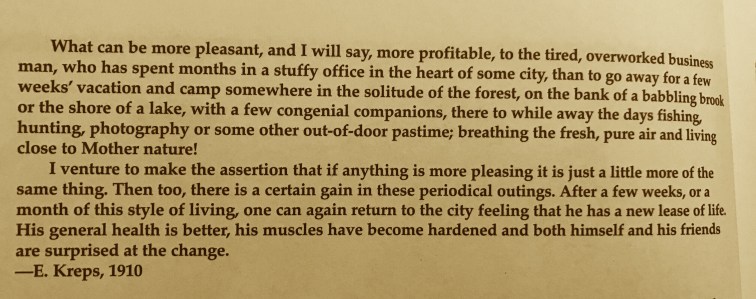
Henry Lawson was born in 1867. In this brief examination we look at Henry Lawson’s time in outback NSW in the early 1890’s where he immersed himself in drought conditions for literary ends. He walks with his mate Jim Gordon. Let’s start with Bruce Elder’s piece in the Griffith Review. Now head over to a piece by ABC Broken Hill. Australian Geographic have this 2011 piece by Barrie Bryan, Retracing Lawson’s historic path
It would appear that the act of walking furthered his creativity, honed his powers of observation and gave him space to dry out from alcohol. I wonder how his deafness contributed to his walk? Here is Henry’s story “Hungerford”
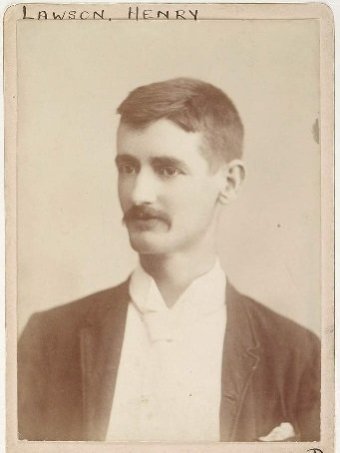
HUNGERFORD
One of the hungriest cleared roads in New South Wales runs to within a couple of miles of Hungerford, and stops there; then you strike through the scrub to the town. There is no distant prospect of Hungerford—you don’t see the town till you are quite close to it, and then two or three white-washed galvanized-iron roofs start out of the mulga.
They say that a past Ministry commenced to clear the road from Bourke, under the impression that Hungerford was an important place, and went on, with the blindness peculiar to governments, till they got to within two miles of the town. Then they ran short of rum and rations, and sent a man on to get them, and make inquiries. The member never came back, and two more were sent to find him—or Hungerford. Three days later the two returned in an exhausted condition, and submitted a motion of want-of-confidence, which was lost. Then the whole House went on and was lost also. Strange to relate, that Government was never missed.
However, we found Hungerford and camped there for a day. The town is right on the Queensland border, and an interprovincial rabbit-proof fence—with rabbits on both sides of it—runs across the main street.
This fence is a standing joke with Australian rabbits—about the only joke they have out there, except the memory of Pasteur and poison and inoculation. It is amusing to go a little way out of town, about sunset, and watch them crack Noah’s Ark rabbit jokes about that fence, and burrow under and play leap-frog over it till they get tired. One old buck rabbit sat up and nearly laughed his ears off at a joke of his own about that fence. He laughed so much that he couldn’t get away when I reached for him. I could hardly eat him for laughing. I never saw a rabbit laugh before; but I’ve seen a ‘possum do it.
Hungerford consists of two houses and a humpy in New South Wales, and five houses in Queensland. Characteristically enough, both the pubs are in Queensland. We got a glass of sour yeast at one and paid sixpence for it—we had asked for English ale.
The post office is in New South Wales, and the police-barracks in Bananaland. The police cannot do anything if there’s a row going on across the street in New South Wales, except to send to Brisbane and have an extradition warrant applied for; and they don’t do much if there’s a row in Queensland. Most of the rows are across the border, where the pubs are.
At least, I believe that’s how it is, though the man who told me might have been a liar. Another man said he was a liar, but then he might have been a liar himself—a third person said he was one. I heard that there was a fight over it, but the man who told me about the fight might not have been telling the truth.
One part of the town swears at Brisbane when things go wrong, and the other part curses Sydney.
The country looks as though a great ash-heap had been spread out there, and mulga scrub and firewood planted—and neglected. The country looks just as bad for a hundred miles round Hungerford, and beyond that it gets worse—a blasted, barren wilderness that doesn’t even howl. If it howled it would be a relief.
I believe that Bourke and Wills found Hungerford, and it’s a pity they did; but, if I ever stand by the graves of the men who first travelled through this country, when there were neither roads nor stations, nor tanks, nor bores, nor pubs, I’ll—I’ll take my hat off. There were brave men in the land in those days.
It is said that the explorers gave the district its name chiefly because of the hunger they found there, which has remained there ever since. I don’t know where the “ford” comes in—there’s nothing to ford, except in flood-time. Hungerthirst would have been better. The town is supposed to be situated on the banks of a river called the Paroo, but we saw no water there, except what passed for it in a tank. The goats and sheep and dogs and the rest of the population drink there. It is dangerous to take too much of that water in a raw state.
Except in flood-time you couldn’t find the bed of the river without the aid of a spirit-level and a long straight-edge. There is a Custom-house against the fence on the northern side. A pound of tea often costs six shillings on that side, and you can get a common lead pencil for fourpence at the rival store across the street in the mother province. Also, a small loaf of sour bread sells for a shilling at the humpy aforementioned. Only about sixty per cent of the sugar will melt.
We saw one of the storekeepers give a dead-beat swagman five shillings’ worth of rations to take him on into Queensland. The storekeepers often do this, and put it down on the loss side of their books. I hope the recording angel listens, and puts it down on the right side of his book.
We camped on the Queensland side of the fence, and after tea had a yarn with an old man who was minding a mixed flock of goats and sheep; and we asked him whether he thought Queensland was better than New South Wales, or the other way about.
He scratched the back of his head, and thought a while, and hesitated like a stranger who is going to do you a favour at some personal inconvenience.
At last, with the bored air of a man who has gone through the same performance too often before, he stepped deliberately up to the fence and spat over it into New South Wales. After which he got leisurely through and spat back on Queensland.
“That’s what I think of the blanky colonies!” he said.
He gave us time to become sufficiently impressed; then he said:
“And if I was at the Victorian and South Australian border I’d do the same thing.”
He let that soak into our minds, and added: “And the same with West Australia—and—and Tasmania.” Then he went away.
The last would have been a long spit—and he forgot Maoriland.
We heard afterwards that his name was Clancy and he had that day been offered a job droving at “twenty-five shillings a week and find your own horse.” Also find your own horse feed and tobacco and soap and other luxuries, at station prices. Moreover, if you lost your own horse you would have to find another, and if that died or went astray you would have to find a third—or forfeit your pay and return on foot. The boss drover agreed to provide flour and mutton—when such things were procurable.
Consequently, Clancy’s unfavourable opinion of the colonies.
My mate and I sat down on our swags against the fence to talk things over. One of us was very deaf. Presently a black tracker went past and looked at us, and returned to the pub. Then a trooper in Queensland uniform came along and asked us what the trouble was about, and where we came from and were going, and where we camped. We said we were discussing private business, and he explained that he thought it was a row, and came over to see. Then he left us, and later on we saw him sitting with the rest of the population on a bench under the hotel veranda. Next morning we rolled up our swags and left Hungerford to the north-west.
Consider this essay by Jono Lineen an Order of Walkers exhortation. Seeds germinate and muscles twitch after reading. Bravo Jono bravo.
Writing in steps
“It is the movement as well as the sights going by that seems to make things happen in the mind, and this is what makes walking ambiguous and endlessly fertile: it is both a means and end, travel and destination.”
Rebecca Solnit, Wanderlust

In my book Into the Heart of the Himalayas I recount a 2700-kilometer solo trek I made traversing the length of the highest mountains in the world. I started the journey knowing I wanted to write a book, but as the walk progressed I realized that the incredible interactions I was having with people and landscape were far beyond anything I had previously experienced. It took me years to understand why and how I had been gifted a glimpse of such beauty but even during the trek I knew that walking in a wonderful way was shifting how I perceived the world. I was…
View original post 1,276 more words
Author Jono Lineen has recently released a new book entitled “Perfect Motion”. Core business for the Order of Walkers. He talks to Hilary Harper on Radio National about his pursuit.
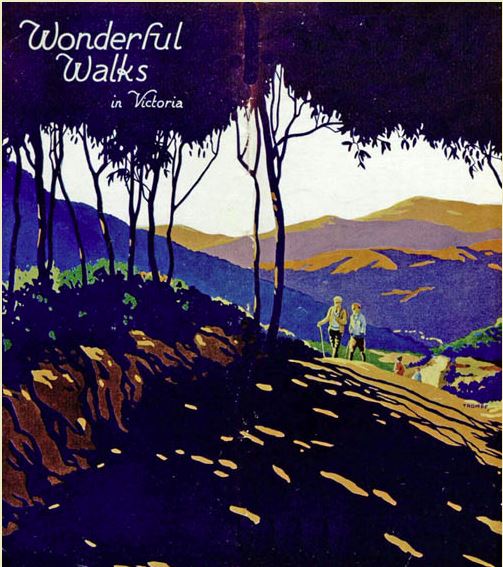
The following passage is an excerpt from the introduction of a book entitled “Wonderful Walks in Victoria”. It was published in 1931 by the “Betterment and Publicity board of the Victorian Railways”. There was a push to get the metropolitan population out and about via the railways. The language is rich and inviting.
Walking for health and pleasure is increasing in popularity in Victoria every year.In recent times the rare beauty of much of Victoria’s countryside, and the splendid grandeur and rich luxuriance of the mountains and valleys of this State have become better and better known.
No holiday season passes without innumerable parties of healthy, enthusiastic boys and men, and, in these days of energetic womanhood, young women, too, taking the road for health and pleasure—pleasure which no other form of travel can give.
Of all forms of exercise, there is, perhaps, none better or more convenient than that of walking. Walking brings us out into the open, where the air is purest. It increases respiration, bringing greater supplies of pure oxygen to the lungs, and insuring a pure blood stream, without which we cannot feel fit and well. It makes the heart beat firmer, and it clears the brain, giving a feeling of exhilaration and well-being which, alone, makes this exercise well worth while.

As a recreation walking is not easily surpassed. As an exercise it is known by all health authorities and students of physical culture to be one of the best which the human being can enjoy.
The walker is master of his own destiny. He may stop where he will and proceed as he likes; he may loiter amid the forest to boil his billy in a delightful spot by the stream; he may diverge as he wishes to enjoy more thoroughly the glories for which our magnificent mountain areas are so notable.
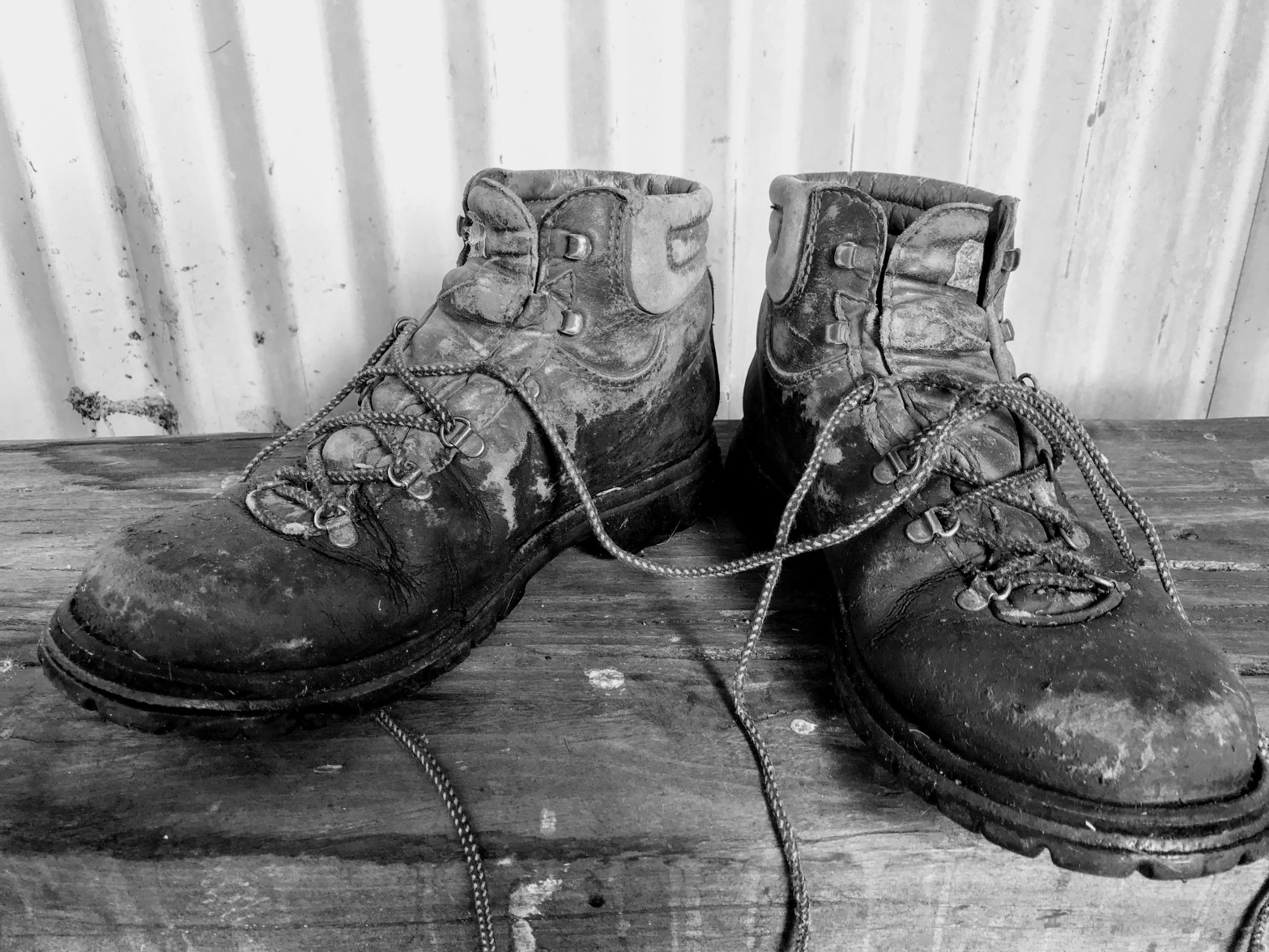
These boots are a pair of Rossiter Scrubs. I adopted them in 1991. They were my goto serious bushwalking boots of the time. They were not worn for any other reason, other than serious walking. Folklore suggested that I was required to own a pair of full leather, thick soled, ankle supporting boots. In the shop, I remember them feeling great; No load on my back, no muscle fatigue, fresh socks. I felt invincible with this sort of armament on my feet. And so, it was with my early twenties body I took to some Victorian mountain in pursuit of some rich experience. At the end of the first day, the honeymoon was over. I sat there at the head of my tent looking at these harbingers of pain. I could not reconcile the fact that I invested so much money in a product whose only dividend was the delivery of said pain.
But I persisted. I tried all sorts of blister treatments and amidst varied success I accepted a modicum of discomfort for the natural wonders I bore witness too. I was expedition walking only a few times a year due to other commitments so I could not financially justify not wearing them. My day walks with these boots could be described as amicable. The type of friend you might see a few times a year, check in with their family welfare, revell in their company for a few hours then say goodbye.
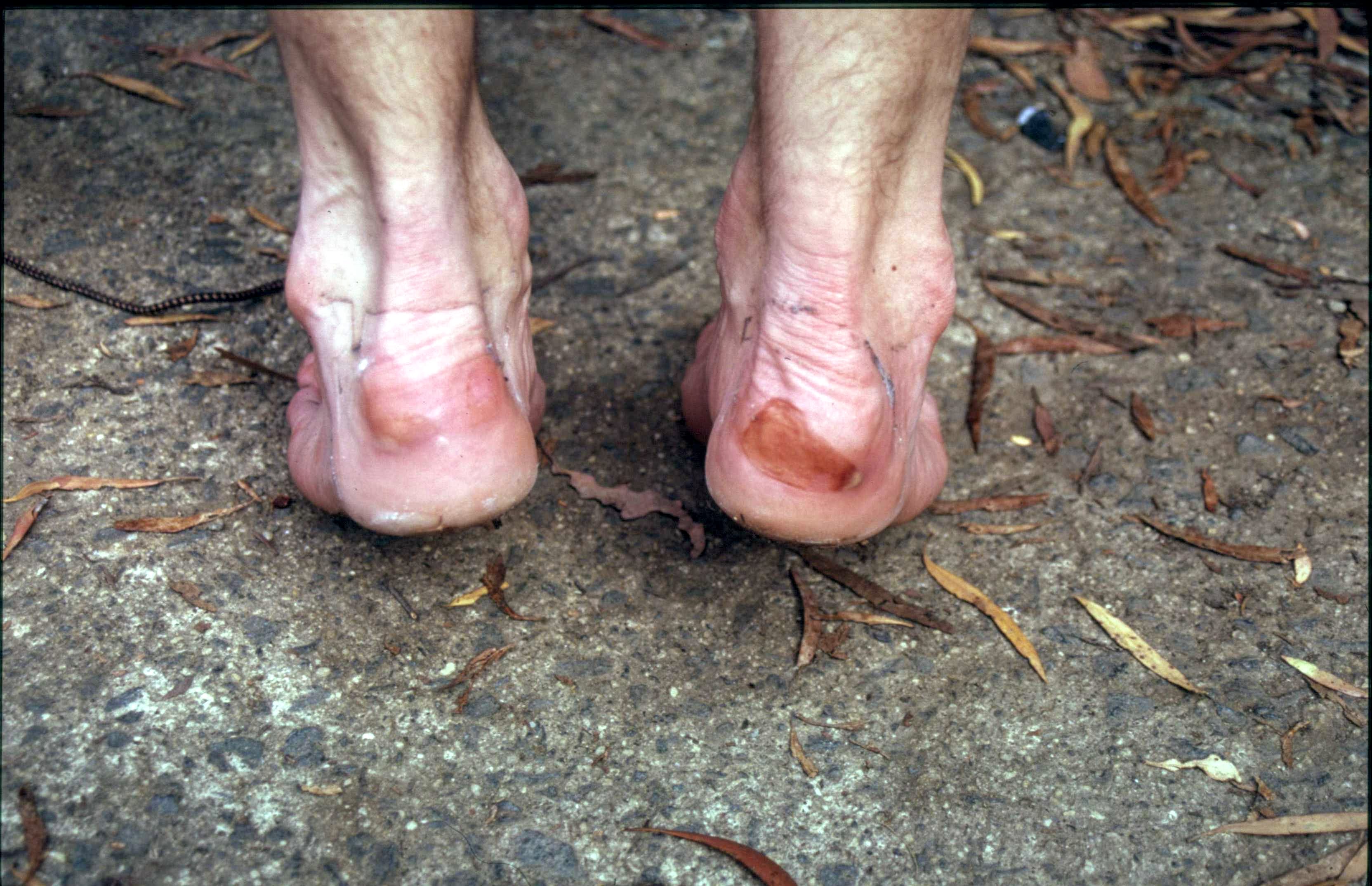
In 2007, after a particularly violent blister episode, I took action and booked a podiatrist appointment. If I was to further my walking in the future I would need some more amenable companions for my feet. The Rossis were proudly presented to my podiatrist when she asked “What boots are you wearing on these bushwalking trips ?” (I had shown her photos). The podiatrist brought me into the contemporary walking boot era, which I had always dismissed due to that folklore thing. I was fitted for orthotics and shelled out the bucks for a pair of lightweight salomon ankle support boots. This indeed changed everything.
Looking at these boots now, I remember some of the walks we partnered on. Overland track, Alpine Track, numerous Prom trips north and south, Wellington River Wonnangatta district, the Otways and Yarra Ranges, Victorian High Country. On all expeditions with load, I had to balance the joy of the wilderness immersion with the knowledge that I was going to suffer painful blisters by the second day.
I will contend that such hardship enables a joy not known to others. Sometimes in private moments at camp, I found myself bellowing like a calf as I removed the boots and introduced my clammy wrinkled white feet to the earth. If the sun was shining and I was able to nap, I could forgive my boots. After a weekend out in inclement weather, the Rossis would be banished to the shed whilst I was tempted to the bath. But in a few days time, I would extend the hand of kindness and, with a stiff brush, clean the Rossis and dress them with a melted beeswax coating on hair dryer warmed leather.
Whilst these boots are no longer in my walking kit, I cannot bear to dispose of them. Due to their full leather design, they are in pretty good nick, and for the odd local wander they feel good (probably because of the orthotics and the change of gait.) They now reside at a remote outstation and if I am taking a short walk I will pull them on, tighten the laces and take the vintage scrubs to the scrub. The feeling of leather binding close to the feet with a pair of explorer socks, is a lightning rod for fond memories and because I can’t remember the pain, I will always show clemency for these boots, living out their days on death row.


 The Order Of Walkers